The Miami Hurricanes enter the 2026 college football season with a roster stacked with potential Heisman Trophy candidates. As the team looks to build on their recent success, including their appearance at the College Football Playoff National Championship at Hard Rock Stadium, five players have emerged as legitimate contenders for college football’s most prestigious individual award.
Being mentioned in the Heisman conversation and actually having a realistic path to winning it are two completely different situations. History has shown that voters tend to reward specific narratives: the transfer who finally has elite weapons around him, the versatile playmaker who defies traditional positions, or the workhorse running back who benefits from defensive attention focused elsewhere.
The Five Miami Hurricanes Players With Heisman Potential
Miami’s current roster features players who fit nearly every archetype that has historically won the Heisman Trophy. Each candidate brings a unique story and skill set that could capture the attention of voters nationwide. For fans of the Latin community following college football, understanding these players’ paths to the award provides insight into what makes a true Heisman campaign.
- Malachi Toney, WR – The multi-dimensional playmaker with preseason hype
- Mark Fletcher Jr., RB – The workhorse back ready to exploit light boxes
- Cooper Barkate, WR – The underdog with an Ivy League origin story
- Damon Wilson II, EDGE – The defensive disruptor chasing history
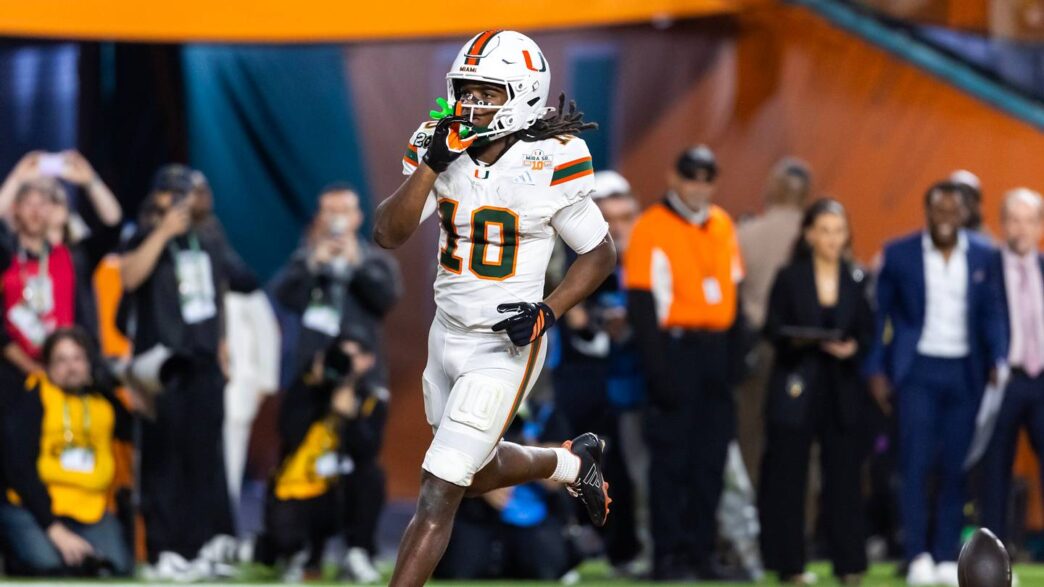
Malachi Toney: The Clear Frontrunner
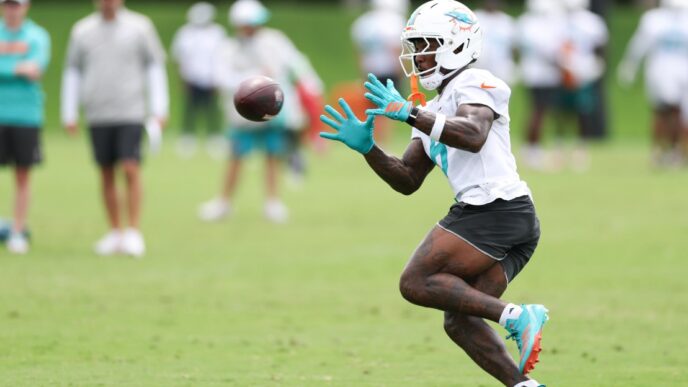
Wide receiver Malachi Toney enters the 2026 season with significant preseason buzz, which is crucial for any serious Heisman campaign. Pure receivers rarely win this award, but the ones who do share a common trait: they contribute beyond just catching passes.
Toney already displays this multi-dimensional profile. During the previous season, he threw for two touchdowns and rushed for another out of Miami’s wildcat package. This versatility mirrors past winners like Desmond Howard, who won in 1991 as much for his punt returns as his receptions, and Travis Hunter, who captured the 2024 award by playing meaningful snaps on both sides of the ball.
If Mario Cristobal’s staff continues expanding Toney’s role, a 1,300-yard receiving season combined with rushing and passing touchdowns would give him the same multi-dimensional case that has actually succeeded before.
For those following Miami Hurricanes coach Mario Cristobal and his recognition on the Dodd Trophy Watch List, the program’s direction suggests Toney will have every opportunity to showcase his talents on the national stage.
Mark Fletcher Jr.: The Workhorse Running Back
Running backs have won the Heisman Trophy numerous times by simply accumulating yards while teammates draw defensive attention elsewhere. Mark Ingram accomplished this in 2009 on an Alabama team loaded with future NFL talent, and Derrick Henry did it in 2015 as a bruising closer on a defense-first squad.
Fletcher’s path to the Heisman is already partially constructed. With teammates like Mensah, Toney, and Barkate forcing defenses to load up against the pass, Fletcher could see lighter boxes throughout the entire season. Historically, workhorse backs who exploit this defensive setup have reached the 1,600 to 1,800 yard range that earns running backs an invitation to New York.
While Miami’s running back room returns several capable players, Fletcher should receive the bulk of carries. His health will be the determining factor in whether he becomes the offensive centerpiece.
Cooper Barkate: The Underdog Story
Barkate’s journey to Miami came through Harvard and Duke, certainly not the traditional path of a Heisman winner. However, underdog origin stories have influenced voters before. Baker Mayfield walked on at Texas Tech before transferring to Oklahoma and winning the 2017 Heisman, with voters embracing his narrative as much as his statistics.
For Barkate to win, he would need to outproduce a crowded receiver room that includes Toney. Realistically, this requires a 1,300-yard season with double-digit touchdowns and at least one signature performance, preferably against a high-profile opponent like Notre Dame. He would also need to establish himself as the unquestioned top receiver, which might only happen if Toney faces an extended injury or draws constant double coverage.
Damon Wilson II: The Defensive Longshot
Charles Woodson in 1997 remains the only modern defensive player to win the Heisman Trophy, and that was nearly 30 years ago on a Michigan team that also captured a national championship. Travis Hunter’s 2024 victory came as a two-way player, keeping the defensive-only path extremely narrow.
Wilson’s candidacy would require a highlight-reel season featuring 12 or more sacks paired with game-deciding plays on national television. Miami would also need to advance to the College Football Playoff, giving voters a reason to examine the defensive side of the ball. While this represents the longest shot among Miami’s contenders, Woodson proved it remains possible when the numbers and memorable moments align.
What This Means for Miami’s 2026 Season
Having multiple Heisman candidates on one roster creates a unique dynamic. Each player’s success partially depends on how defenses choose to allocate their resources. If opponents focus on stopping Toney, Fletcher benefits from lighter boxes. If defenses spread their attention, Barkate could emerge as the primary target.
For the Latin community following college football in South Florida and beyond, the 2026 Miami Hurricanes offer compelling storylines regardless of which player ultimately receives Heisman recognition. The team’s national championship appearance demonstrated their ability to compete at the highest level, and individual awards would further cement the program’s resurgence under Cristobal’s leadership.
The Heisman Trophy race officially begins when the regular season kicks off, but Miami’s candidates have already established the foundation for legitimate campaigns that could bring the award back to Coral Gables.