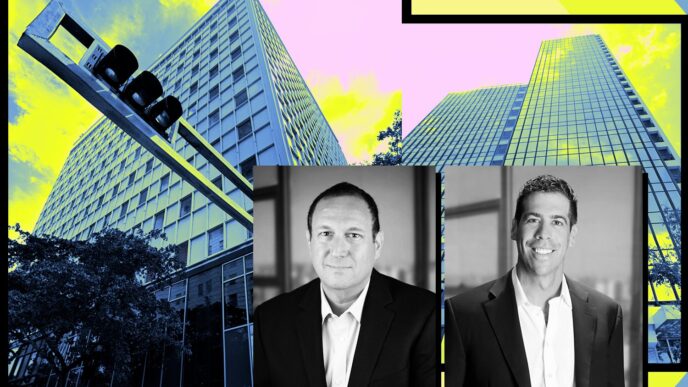

Two ambitious real estate developers are placing a massive bet on the future of Miami Beach’s legendary Lincoln Road, investing heavily in projects designed to breathe new life into what was once the city’s most prestigious retail corridor. The transformation aims to create walkable, pedestrian-oriented spaces that will attract both locals and tourists alike.
A Tale of Two Developments on Lincoln Road
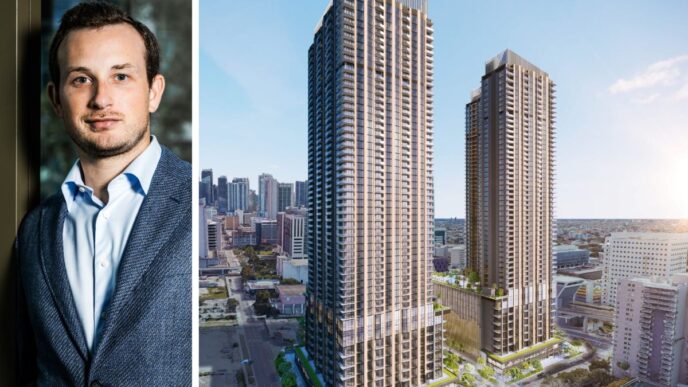
Michael Comras of The Comras Company and Peter Kanavos of Flag Luxury Group are spearheading separate but complementary projects at opposite ends of Lincoln Road. Their shared vision centers on restoring the glamour and vibrancy that once made this Miami Beach strip a world-renowned shopping and dining destination.
The iconic pedestrian corridor reached its peak nearly a decade ago when retail rents soared to $300 per square foot. Those sky-high prices eventually drove out national retailers and upscale restaurants, leaving the street struggling to maintain its identity. The COVID-19 pandemic only intensified these challenges, forcing Lincoln Road to spend years trying to regain its footing amid changing consumer preferences and economic pressures.
“My vision really is taking backs of buildings and creating second fronts. I don’t think we should have backs of buildings, not in an urban environment. Everything should be a front.”
The NoLi District: Transforming Alleys into Destinations
The Comras Company is preparing to launch an innovative retail district called NoLi, short for North Lincoln. This ambitious project will transform a collection of properties and a service alley into a vibrant pedestrian-oriented shopping area spanning approximately 150,000 square feet.
In November, the firm invested $140 million to acquire 11 storefronts from Morgan Stanley. The properties are located at 600, 719-737, 741, 801-821 Lincoln Road, and 723 North Lincoln Lane. The acquisition was financed through a $117 million loan from San Francisco-based Acore Capital.
Key features of the NoLi development include:
- Via NoLi: An 18-foot-wide pedestrian passageway carved through the former Forever 21 building
- NoLi Plaza: A central gathering space featuring café seating and a decorative fountain
- Transformed service alleys converted into attractive pedestrian walkways
- Expanded sidewalks with outdoor seating areas for restaurants and cafés
- Retail spaces ranging from 400 to 4,000 square feet for boutique shops
The redevelopment carries a $30 million price tag, financed through the original property loan. Demolition work began as the development team navigates the city’s permitting process, with full-scale construction expected to commence in September 2026.
Current Market Conditions and Challenges
Despite appearances, the Lincoln Road retail strip maintains an 80 percent occupancy rate, not including pending leases. According to Colliers data from the second quarter, Miami Beach recorded a direct retail vacancy rate of just 4.4 percent.
Lyle Stern, president of the Lincoln Road Business Improvement District, explained that many storefronts appearing empty are actually leased and simply awaiting permits or tenant build-outs. The city’s historically time-consuming permitting process has shown improvement, he noted.
Rents have decreased significantly from their peak, now ranging from $120 to $200 per square foot. However, property owners face substantial additional costs that get passed on to tenants:
- Insurance costs: Significant and rising annually
- Real estate taxes: Combined with insurance, can add $30 to $70 per square foot
- Maintenance and common area expenses
- Build-out and improvement costs
Addressing Lincoln Road’s Fragmentation Problem
Comras identified one of Lincoln Road’s fundamental challenges: the extreme fragmentation of property ownership. With approximately 40 different property owners controlling over a million square feet of retail space, coordination and unified vision have been nearly impossible to achieve.
The developer noted that property owners acquired their holdings at vastly different times and price points. Some inherited properties from previous generations with minimal cost basis, while others purchased at peak prices a decade ago. This disparity creates conflicting agendas and makes comprehensive revitalization difficult.
By acquiring multiple adjacent properties, the Comras Company aims to create a cohesive retail experience with appropriately sized boutique spaces. This stands in contrast to the large-format stores typically occupied by national chains like Zara and Nike that currently dominate portions of the corridor.
The projects at both ends of Lincoln Road represent what Stern called the street’s next evolution—creating destinations that connect neighborhoods and encourage local residents, not just tourists, to spend time exploring, shopping, and dining in the area. If successful, these developments could serve as a model for revitalizing other struggling retail corridors across South Florida.