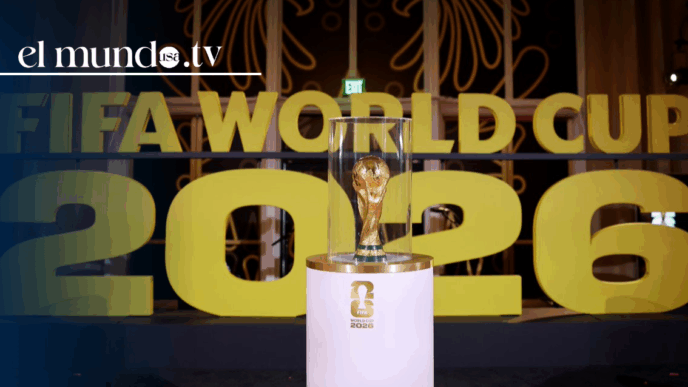


The ongoing conflict between the United States and Venezuela is beginning to extend beyond political and military spheres, now reaching the international sports arena. Analysts warn that rising diplomatic tensions could create a new layer of uncertainty around the organization of the Mundial 2026, whose primary host is the United States, alongside Mexico and Canada.
Although planning for the tournament is well underway, the geopolitical context has sparked debate about how an international conflict might affect an event of this magnitude. To date, FIFA has not issued an official statement, but the issue is already circulating in international media and specialized forums.
International Debate on the Mundial 2026 Host
The possibility that the Mundial 2026 could be affected has generated discussion across the global sports community. Experts note that while the United States serves as the main hub for organization, any review of the tournament would need to consider logistical, financial, and security factors, as well as the role of Mexico and Canada as co-hosts. Sports governance specialists highlight that, while FIFA defines itself as independent and apolitical, it has previously intervened when international circumstances threatened the integrity of its competitions.
Social Media Outcry and Comparisons to Russia
On social media, users and activist groups have demanded treatment similar to that applied to Russia, which was excluded from international competitions following its invasion of Ukraine. Some argue that, based on this precedent, the United States should also face potential sporting sanctions for its intervention in Venezuela, including a review of its role as Mundial 2026 host.
FIFA’s Position and Mexico and Canada’s Response
So far, FIFA has remained silent regarding potential consequences for the Mundial 2026, while Mexico and Canada continue preparations according to plan without expressing formal concerns. As the largest tournament in history approaches, the spotlight is on whether FIFA will maintain its cautious stance or respond to growing international pressure to evaluate the impact of geopolitical tensions on the event.