
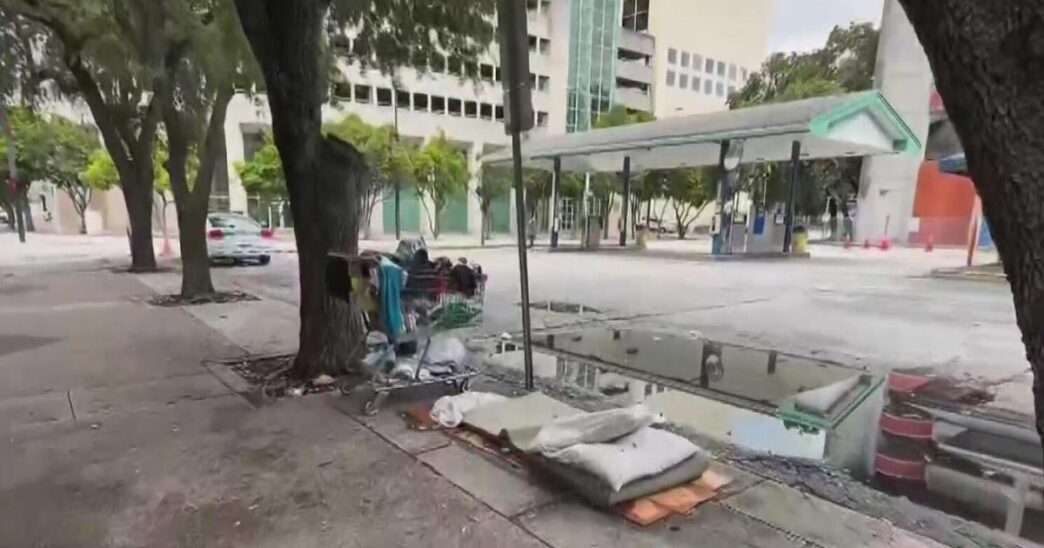
In a decision that has sparked intense debate across South Florida, the Miami City Commission voted on July 24, 2026, to approve a controversial ordinance granting police officers the authority to arrest individuals found sleeping in public spaces. The measure, which passed with a narrow 3-2 vote, will take effect in 10 days and represents the latest effort by local officials to address the growing homelessness crisis in one of America’s most vibrant cities.
Key Provisions of the New Miami Ordinance
The newly approved law establishes a specific protocol that law enforcement officers must follow before making any arrests. Under the ordinance, police are required to issue a verbal warning to individuals sleeping in public areas and must provide them with what the city defines as a “reasonable” amount of time to gather their belongings and leave the location.
The measure includes several important stipulations designed to prevent arbitrary enforcement:
- Police must provide a verbal warning before taking any action
- Individuals must be given adequate time to collect their personal belongings
- Arrests cannot be made if there are no available shelter beds at the time of the encounter
- Officers must document the interaction according to department protocols
The ordinance aligns Miami’s local policy with a statewide law enacted in 2025 that prohibited sleeping in public spaces across Florida. City officials have argued that the local measure provides necessary guidelines for how police should enforce the state mandate within Miami’s jurisdiction.
Support and Opposition Divide the Community
Miami Police Chief Edwin Lopez has been among the most vocal supporters of the new ordinance. During previous commission meetings leading up to the vote, Lopez emphasized that enforcement has been measured, noting that only two individuals have been arrested for sleeping on public streets throughout 2026.
“The ordinance does nothing to solve the actual unhoused person’s situation, but actually exacerbates it,” declared one resident during the public comment session that preceded the commission’s vote.
The debate over the ordinance has revealed deep divisions within Miami’s diverse community. Critics argue that the measure criminalizes poverty and homelessness rather than addressing the root causes that leave people without shelter. Housing advocates have pointed out that jail time does nothing to help individuals find stable housing, employment, or access to mental health services.
Meanwhile, some residents have expressed concern about the impact of homeless encampments on public spaces. Michael Nezeza, a downtown runner who regularly passes through areas where encampments have formed under bridges and near government buildings, shared his observations about the situation.
“I think it’s progressively gotten worse,” Nezeza stated. “Cities like New York, L.A., they’re known for having a lot of homelessness, so I think Miami is trying to steer away from that.”
Voices from Those Directly Affected
Perhaps the most compelling testimony came from individuals who have personally experienced homelessness. Latoya, a Miami resident who declined to share her last name, spoke passionately about why the threat of arrest fails as a strategy to address the homelessness crisis.
“I’m glad I wasn’t arrested by someone that doesn’t even know my situation,” Latoya explained. “That’s not fair. You don’t even know me, but you’re ready to put me in jail instead of helping my situation.”
Her words highlighted a fundamental concern raised by many critics: that enforcement-focused approaches fail to recognize the complex circumstances that lead individuals to homelessness, including job loss, mental health challenges, domestic violence, and economic hardship.
The debate also revealed mixed feelings among community members about what constitutes appropriate care for the unhoused population. One speaker at the commission meeting argued that simply allowing people to live on the streets “is not the standard of care they deserve,” suggesting that some form of intervention is necessary but questioning whether criminalization is the right approach.
What Comes Next for Miami
As the ordinance prepares to take effect, advocacy groups and community organizations are closely monitoring how it will be implemented. The requirement that arrests cannot occur when shelter beds are unavailable could prove significant, as homeless shelter capacity remains a persistent challenge in major urban areas.
The Miami City Commission’s decision reflects a broader national conversation about how cities should respond to visible homelessness while balancing public safety concerns with compassion for vulnerable populations. As South Florida continues to grapple with housing affordability issues, the effectiveness and fairness of this approach will likely remain under scrutiny for months to come.