Cuban artist and dissident Luis Manuel Otero Alcántara touched down at Miami International Airport on July 19, 2026, marking the end of a five-year imprisonment that drew international condemnation and sparked calls for his release from human rights organizations worldwide. The co-founder of the San Isidro Movement was greeted by supporters who wrapped him in a Cuban flag bearing the words “Patria y Vida” — the title of a Grammy-winning song that has become synonymous with Cuba’s opposition movement against government repression.
A Long-Awaited Arrival After Years of Imprisonment
The moment Alcántara emerged through the international arrivals doors was captured on video and shared across social media platforms, showing the emotional reunion between the activist and his supporters who had campaigned tirelessly for his freedom. The United States government granted him parole earlier in the week of July 19, 2026, according to a social media page operated by his friends and advocacy network. His release came with a difficult condition: permanent exile from his homeland.
Alcántara’s supporters confirmed that he accepted exile as the only viable path to escape continued persecution and maintain his artistic and activist work. The decision to leave Cuba permanently represents both a victory and a sacrifice for the artist, who must now continue his advocacy from American soil rather than from the Havana neighborhood that gave his movement its name.
First Words of Freedom on American Soil
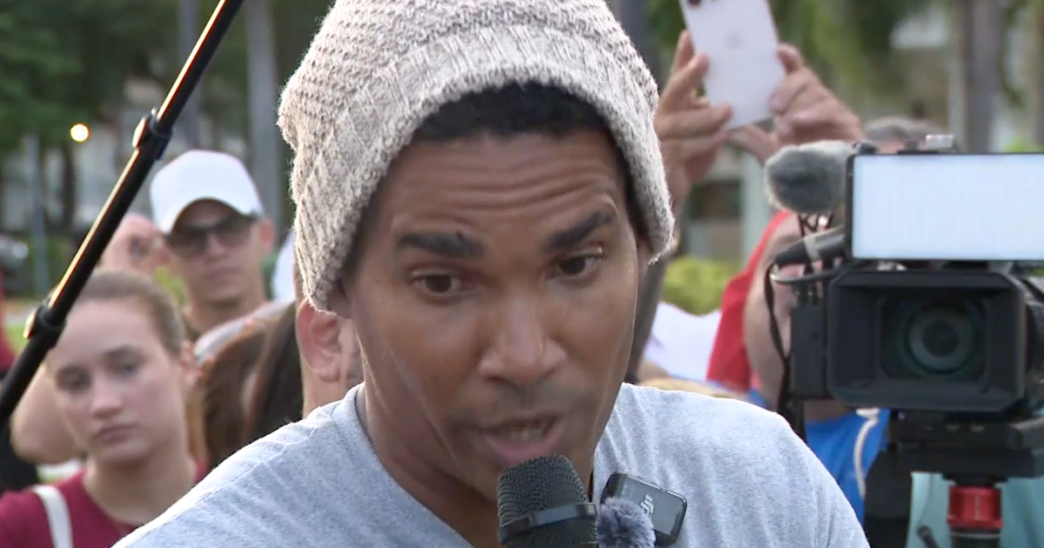
Speaking to the crowd gathered to welcome him, Alcántara delivered his first words in English with palpable emotion, exclaiming “Super bien! Very good. Very good!” The artist, visibly moved by his newfound freedom, expressed that the joy he felt upon his release is what he wishes for every Cuban citizen still living under the island’s government.
“Luis Manuel is not a criminal. He is a Cuban patriot whose only fault was refusing to be silenced.” — U.S. Representative Carlos Gimenez
The congressman’s statement, posted on the social media platform X following Alcántara’s release, reflected the sentiment shared by many who view the artist as a symbol of peaceful resistance against authoritarian rule. His case had become a focal point for discussions about political freedom and human rights in Cuba.
The San Isidro Movement and July 2021 Protests
Alcántara rose to international prominence as a co-founder of the San Isidro Movement, a collective of Havana-based artists, writers, and musicians named after the neighborhood where he resided. The movement became a rallying point for creative expression and political dissent in Cuba, challenging government restrictions on artistic freedom and civil liberties.
The activist was arrested during the historic nationwide protests that erupted across Cuba on July 11, 2021. Those demonstrations represented the largest public display of dissent the island had witnessed in decades, with thousands of Cubans taking to the streets to demand freedom and express frustration with economic conditions and government policies. Following his arrest, Alcántara faced charges including:
- Public disorder
- Contempt of authority
- Disrespect toward national symbols
His conviction and subsequent incarceration in a maximum-security facility drew sharp criticism from organizations including Amnesty International, which designated him a political prisoner. The Cuban government consistently rejected this characterization, maintaining that his prosecution was based on legitimate criminal charges.
Days of Uncertainty Before Freedom
The path to Alcántara’s release was marked by confusion and concern in the days leading up to his arrival in Miami. Although he was expected to be freed the week prior to July 19, 2026, advocates reported being unable to contact him or confirm his whereabouts for several anxious days. The organization Cubalex, which provides legal assistance to dissidents and documents human rights violations from outside Cuba, filed a habeas corpus petition on his behalf on July 14, 2026.
Until Alcántara actually boarded the plane bound for Miami, his supporters remained uncertain about his location and whether his release would truly materialize. The uncertainty highlighted the opaque nature of the Cuban justice system and the challenges faced by those advocating for political prisoners on the island.
A Symbol of Hope and Continued Advocacy
Upon his arrival, Alcántara announced that his first destination on American soil would be the Shrine of Our Lady of Charity, where he planned to make an offering. He brought with him from Cuba a broken statue of the Virgin Mary, which he described as representing hope, healing, and the possibility of reconstructing something meaningful from fragments — a powerful metaphor for both his personal journey and his vision for Cuba’s future.
The artist delivered a direct message to those remaining in Cuba, urging continued resistance despite the personal costs involved. His words carried the weight of lived experience, having endured years of imprisonment for his beliefs.
Advocates emphasized that other political prisoners remain incarcerated in Cuba, including fellow artist and collaborator Maykel “Osorbo” Castillo Pérez, who shared the Grammy Award for “Patria y Vida” with Alcántara. Supporters expressed hope that Alcántara’s release would generate renewed pressure for Pérez and others to also be freed, keeping international attention focused on Cuba’s political prisoners.